Facebook Teaser Post
Looking to build a contact center without technical headaches?
Discover how custom contact center solutions help businesses scale, integrate, and adapt with confidence.
👉 Read the full guide.
Looking to build a contact center without technical headaches?
Discover how custom contact center solutions help businesses scale, integrate, and adapt with confidence.
👉 Read the full guide.
Custom contact center solutions are no longer reserved for massive enterprises with large IT teams. Today, businesses of all sizes need flexible, scalable platforms that support voice, SMS, web, and emerging digital channels—all without getting lost in technical complexity.
While technologies like Asterisk often power these systems behind the scenes, decision-makers care more about outcomes: better customer experiences, productive agents, and systems that adapt as the business grows. Therefore, building a modern contact center starts with strategy, not software installation.
Before choosing tools or providers, businesses must decide how they want their contact center deployed.
For example, some organizations prefer cloud-based contact centers for flexibility and faster deployment. Others choose on-premise or hybrid models due to compliance or data control requirements.
Regardless of deployment type, the infrastructure should:
Scale easily as call volume grows
Support modern technologies like WebRTC
Remain resilient with high availability and redundancy
A well-designed platform handles these complexities behind the scenes, allowing teams to focus on operations instead of maintenance.
Next, successful custom contact center solutions clearly define how customers will connect.
Most modern contact centers support:
Voice calls
SMS and messaging
Web-based calling via WebRTC
API-driven integrations with third-party tools
Rather than locking into a single provider, flexible platforms allow businesses to work with providers like Twilio or existing SIP trunking partners. As a result, organizations retain control while avoiding vendor lock-in.
Agent experience directly impacts customer satisfaction. Therefore, building a contact center means understanding how agents will work day to day.
Some teams rely on:
Live human agents
AI-powered agents for basic interactions
Blended models combining automation and human expertise
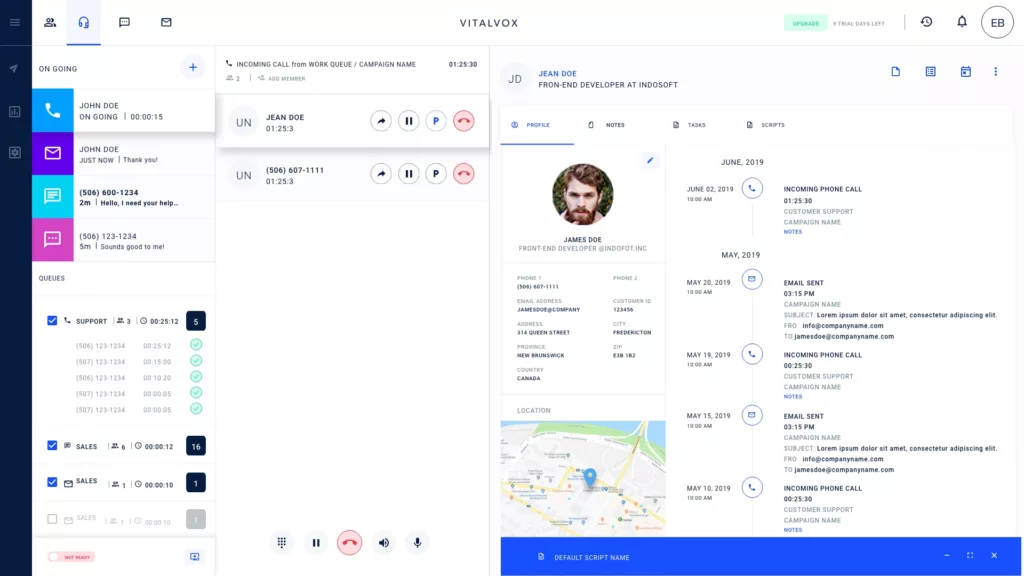
Additionally, agents need intuitive interfaces, real-time data, and tools that simplify workflows. When systems are designed correctly, training time decreases while productivity increases.
Once infrastructure and agents are in place, attention shifts to campaign design.
Effective contact centers define:
Clear business goals
Call flows and scripts
Data collection and reporting requirements
At this stage, integration becomes critical. CRM systems, analytics platforms, and third-party applications must work together seamlessly. A unified contact center platform simplifies this process while ensuring data flows smoothly across systems.
Q Suite is designed to support custom contact center solutions without forcing businesses into rigid architectures.
The platform:
Works with multiple providers and deployment models
Supports voice, messaging, and WebRTC-based communications
Abstracts complex telephony logic behind a user-friendly interface
Scales across industries and use cases
As a result, businesses gain enterprise-grade flexibility without managing low-level telephony infrastructure.
No two contact centers are identical. A legal intake team has different needs than a plumbing dispatch service or a public safety organization.
That’s why generalized platforms matter. By starting with a flexible foundation, businesses can later tailor workflows, scripts, and integrations to specific verticals—without rebuilding the system.
If you’re exploring custom contact center solutions and want expert guidance without technical overwhelm, we’re here to help.
Contact us today to discuss your use case and see how Q Suite can support your contact center strategy.
What is a custom contact center solution?
A custom contact center solution is a flexible platform designed to adapt to specific business needs, communication channels, and workflows.
Do I need technical expertise to build a contact center?
No. Modern platforms abstract technical complexity, allowing non-technical teams to manage and scale operations easily.
Is Asterisk required for modern contact centers?
Asterisk may be used behind the scenes, but most businesses interact with higher-level platforms that manage telephony logic automatically.
How does WebRTC improve contact centers?
WebRTC enables browser-based calling, reducing hardware needs and improving agent flexibility.